
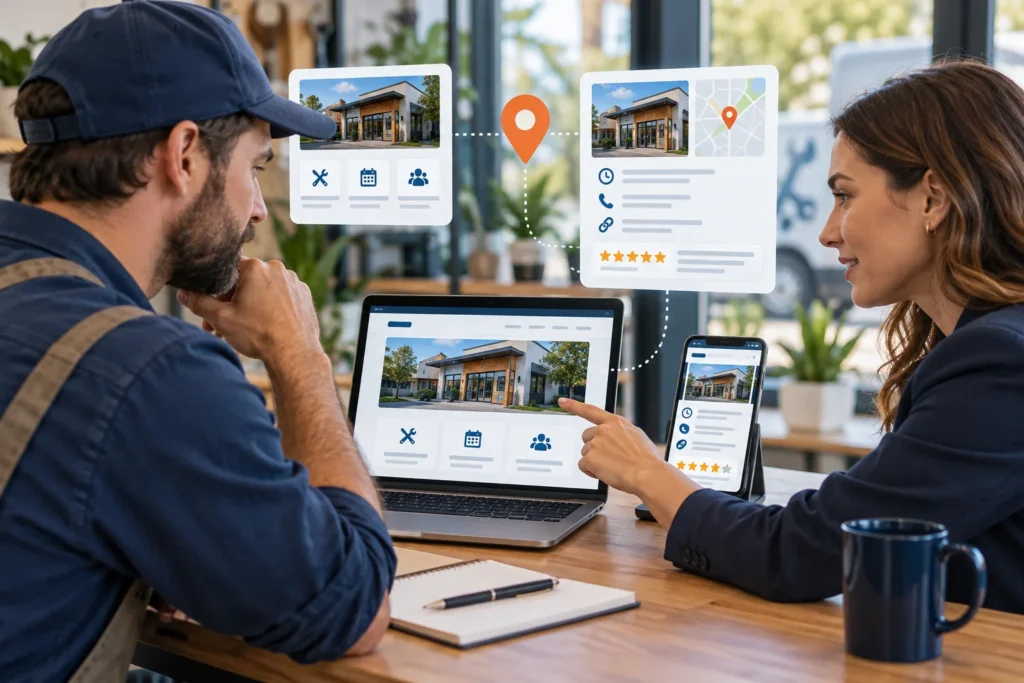
Local visibility becomes more useful when the information customers see in Google Search, Maps and your website tells one consistent, credible story.
A Google Business Profile can help a local company appear when nearby customers search for a service, but the profile should not operate as an isolated marketing channel. Prospects move between Maps, search results, reviews and the company website while deciding whether to call. Conflicting hours, vague services or a weak landing page creates hesitation at the moment trust matters most.
Understand what local customers are comparing
Google explains that local results are mainly influenced by relevance, distance and prominence. A business cannot change a searcher’s location, but it can improve the accuracy and usefulness of the information that supports relevance and trust. Start by viewing the experience as a customer would.
Search the business name, primary services and important local queries on a phone. Compare the profile, website, contact page and location pages. Note any mismatched names, phone numbers, opening hours, categories, service descriptions or URLs. Consistency does not mean repeating identical marketing copy; it means the underlying facts agree.
Choose the right website destination
The main website link on a single-location profile normally points to the most useful canonical page for that business, often the homepage or a strong location page. A multi-location company should link each profile to its corresponding branch page rather than sending every visitor to a generic homepage.
The destination must immediately confirm that the visitor is in the right place. Show the business identity, primary service, location or coverage area, and a clear next step above the fold. On mobile, the phone and enquiry actions should be easy to use without obscuring the content.
Keep core business information accurate
Create a simple source-of-truth document for the business name, public phone number, address or service area, opening hours, holiday hours, primary category, additional categories and website URLs. Assign one person to approve changes across the website and profile.
If the business relocates, changes its phone system or adjusts opening hours, update every owned surface promptly. A customer who drives to an old address or calls outside newly changed hours may not give the company another chance.
Describe services in customer language
Profile categories and services should reflect the work customers can actually buy. The website should then explain those services in greater depth: who they are for, common problems, process, proof, limitations and next steps. Avoid listing services simply because they have attractive search volume.
Use natural terminology customers recognise. If the trade or profession uses different names in the US and UK, write for the target market rather than forcing every variation into one paragraph. Clear language improves both conversion and search understanding.
Build useful location pages
A branch page should be more than an address block. Include directions, parking or transport information, accessibility details, staff or service availability, contact options, hours, local proof and relevant FAQs. For businesses that visit customers, be transparent about the service area and how appointments or call-outs work.
Each genuine location can use accurate LocalBusiness structured data. The markup should match information visible on the page and use the most specific appropriate business type. Validate the code before publishing; structured data is clarification, not a substitute for a useful page.
Use reviews as evidence, not decoration
Reviews often answer concerns that company copy cannot. Look for recurring themes about communication, punctuality, clarity or outcomes, then strengthen the website sections that support those expectations. Ask customers for honest feedback without scripts that pressure them to use keywords.
When quoting a review on the website, obtain permission where needed, keep the wording faithful and link to a public source when practical. Do not add review structured data that misrepresents first-party testimonials or violates platform rules.
Connect profile activity to website measurement
Add campaign parameters to the website link where appropriate so analytics can separate profile visits from other traffic. Track phone-link clicks, form completions, booking starts and successful enquiries. The objective is not simply more profile views; it is more suitable customers taking a useful action.
Use a consistent measurement plan. Record the landing page, source, service interest and location when a lead is created. Later, compare qualified leads and completed sales rather than judging the channel only by clicks.
Publish updates that lead somewhere useful
Profile updates can highlight a seasonal service, new guide, event or operational change. Link each update to a page that delivers on the promise. Sending visitors to a generic homepage after a specific message adds friction and makes the campaign harder to measure.
Run a monthly alignment check
- Confirm hours, contact details, categories and website links.
- Check that profile services match current website offers.
- Review new questions and answer them accurately.
- Test the website destination and forms on a real phone.
- Read recent reviews for recurring customer needs.
- Compare enquiries, qualified leads and missed calls.
For multi-location companies, maintain a checklist per branch. Local managers can flag operational changes, while one central owner protects naming, tracking and brand consistency.
Key takeaway
Your profile earns the click; your website earns the enquiry. Accurate facts, location-specific landing pages, credible proof and reliable measurement make those two surfaces work as one customer journey.
Turn local visibility into a clearer customer journey
RATdeck can review your profile-to-website path, location pages, structured data and lead tracking.